



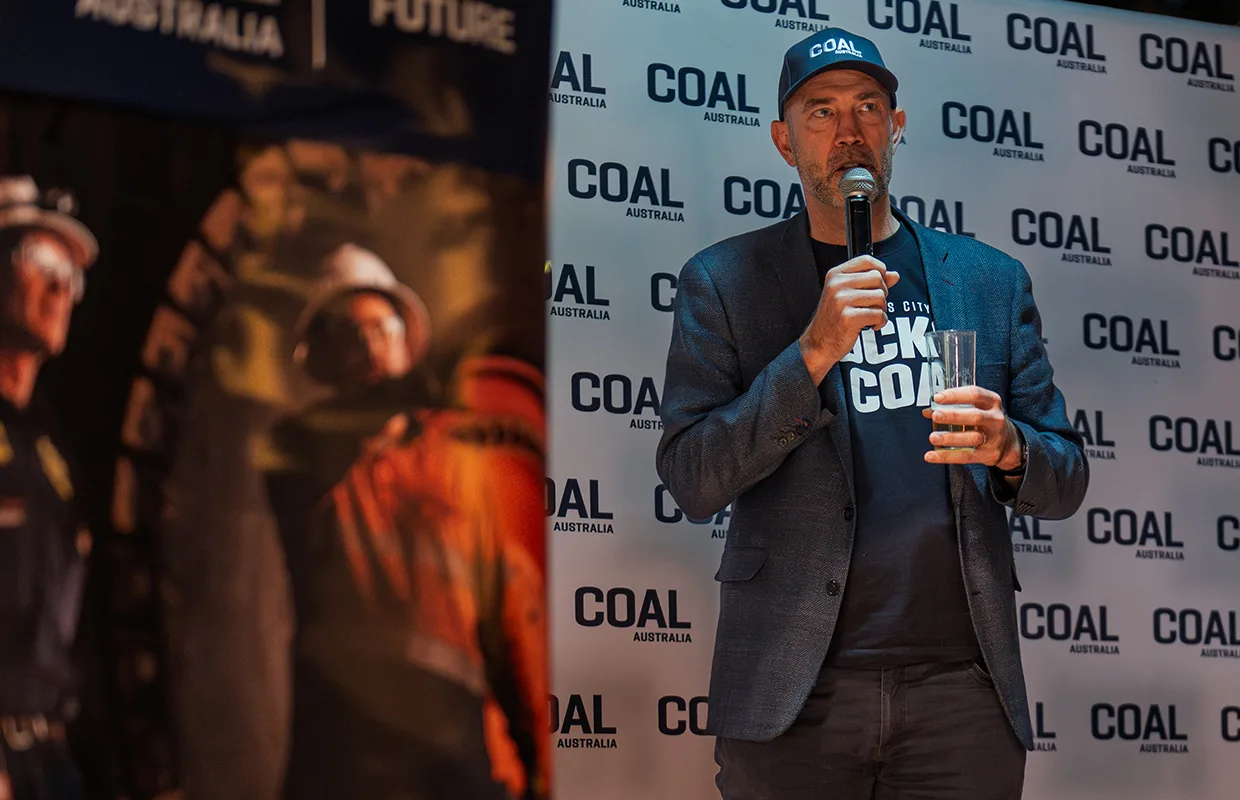
Nick Jorss, Founder of Coal Australia, candidly discusses the driving force behind his company, sheds light on the often-misunderstood coal industry – advocating for its pivotal role in the nation’s economy – and explores ways to reshape public discourse around coal’s future.
Q&A WITH NICK JORSS, FOUNDER, COAL AUSTRALIA
Firstly, could you introduce Coal Australia, its mission, vision, and key achievements since its inception?
Nick Jorss, Founder (NJ): Coal Australia is the dedicated national voice for the country’s coal industry.
As a not-for-profit membership organisation, we represent the people and companies committed to building a secure future for Australian coal – thermal and metallurgical producers, suppliers, customers, employees, local businesses, and our critical coal communities.
Coal Australia has an agile team and is run by our indomitable CEO, Stuart Bocking, with a goal to promote the positive contribution coal makes to the country, bring rightful pride back to the industry and our coal communities, improve public understanding of what coal is used for, advocate for public policy that allows the industry to keep investing here, and support the next generation of skilled workers.
In simple terms, Coal Australia exists because coal has become an industry everyone talks about, but too few people are prepared to speak for it directly.
Since our launch in 2023, we have made a real impact. Our grassroots Ready & Reliable campaign has reached millions of Australians; we have built a 140,000-strong Friends of Coal network, held town halls in coal regions, secured support from political and industry leaders, and put pride back into an industry vital to Australia’s prosperity.
That is the achievement I am most proud of: coal workers and communities finding their voice again.
How do government policies and regulations affect the coal industry, and what economic benefits can coal provide?
NJ: Government policy is one of the biggest determinants of whether coal investment stays in Australia or moves offshore. The industry understands that it must pay its fair share, just as it always has.
Unfortunately, in Australia, policy goals have stopped being about fair returns to the community and become a blunt political weapon.
For instance, the coal royalty regime in Queensland (QLD) is the clearest example of a punitive policy that increases costs and risks the coal industry.
Specifically, it taxes revenue, not profit, with the top tier applying at 40 percent to revenue above the relevant threshold, meaning a mine can be losing money and still pay enormous royalties before it pays investors or reinvests in jobs, equipment, and communities.
That is not a sustainable tax system. It puts mines, workers, suppliers, and future royalties at risk.
The economic contribution of coal to Australia is not theoretical – it remains the country’s second-largest export after iron ore, contributing tens of billions of dollars to the economy, directly employing tens of thousands of Australians, and supporting hundreds of thousands more in regional supply chains.
Coal royalties and taxes help fund schools, hospitals, police, roads, and other public infrastructure. A fair policy framework would not put this at risk; it would support the communities and services that rely on the industry’s success.

“Coal royalties and taxes help fund schools, hospitals, police, roads, and other public infrastructure. A fair policy framework would not put this at risk; it would support the communities and services that rely on the industry’s success”
Nick Jorss, Founder, Coal Australia
What strategies can be implemented to reclaim the narrative around coal, emphasising its contributions to Australia’s economy and the importance of effective public policy to support the sector?
NJ: “Coal does not need a sympathy campaign. It needs a facts campaign.
The first step is to stop apologising for an industry that Australians rely on every day. In fact, coal keeps the lights on, makes steel, supports regional communities, and earns export income for the nation – that is not a marginal story, but a national prosperity story.
The second step is to put people and facts at the centre of the debate. To achieve this, Coal Australia has focused on town halls, local sponsorships, supporters, merchandise, digital campaigns, and direct engagement because the best advocates for coal are the workers, families, suppliers, and communities who live its contribution.
Furthermore, the industry’s opponents often speak in slogans, and we need to answer with facts, faces, and local consequences.
The third step is policy discipline – we need to advocate for internationally competitive royalties, faster, more predictable approvals, a workable emissions policy, the restoration of access to finance and insurance, and recognition that both metallurgical and thermal coal remain important.
Reclaiming the narrative is about making sure decisions are made on evidence, not ideology.
What specific challenges do coal producers and communities face in adapting to changing market demands and environmental regulations, both domestically and globally?
NJ: Coal producers operate in a global market, but many of the biggest pressures are domestic and policy-created.
Prices move in cycles, and costs have risen sharply; approvals are slow and uncertain, whilst finance and insurance have become harder to secure. Additionally, environmental and emissions requirements are increasingly complex.
If you combine those pressures with excessive royalties, you can turn a world-class resource into an uninvestable project – communities feel that first.
A coal mine is not just a mine; it represents apprenticeships, engineering firms, trucking businesses, workshops, local sport, schools, housing demand, and council revenue. When investment stops, the first people hurt are often the small businesses and young workers who have the least ability to absorb the shock.
Globally, the demand for coal is not disappearing; it is actually increasing. In fact, it currently sits at a record high.
If Australia withdraws from supply, customers do not stop needing energy or steel. They buy from elsewhere, often from countries with lower environmental, safety, and labour standards.
This leads to the uncomfortable fact at the heart of the coal debate – shutting down high-standard Australian supply does not reduce global demand; it simply shifts supply to competitors.
How does Coal Australia plan to address environmental concerns associated with coal mining whilst advocating for the industry’s role in sustainable energy solutions? What steps can the coal industry take to enhance its reputation as a responsible sector?
NJ: We address environmental concerns directly, not defensively. Coal mining already meets very high standards for safety, water management, dust control, land rehabilitation, biodiversity, methane emissions, and community engagement.
However, the industry has to keep improving and be transparent about those improvements.
At the same time, the environmental debate has to be honest about trade-offs. Coal is a key input into steel, which is required for homes, hospitals, roads, bridges, transmission towers, wind turbines, solar farms, and the infrastructure of modern life.
Moreover, reliable, affordable energy is also essential to economic and social well-being. Coal’s role in a sustainable future is not to replace every other technology; it is to provide reliability and materials the world still needs whilst we pursue practical emissions-reduction technologies.
The industry’s reputation will improve when it shows, not just tells. That means publishing rehabilitation outcomes, bringing journalists and politicians to sites, highlighting local procurement, apprenticeships, and Indigenous employment, supporting schools and sport, and being honest when standards need to be lifted.
The industry should be proud of its contribution, but that pride must be matched by performance.
“We address environmental concerns directly, not defensively. Coal mining already meets very high standards for safety, water management, dust control, land rehabilitation, biodiversity, methane emissions, and community engagement”
Nick Jorss, Founder, Coal Australia
What role does coal play in the Australian steel industry, and how might shifts to greener technologies affect this relationship?
NJ: Metallurgical coal is not just another fuel; it is a raw material in the dominant steelmaking method.
Around the world, 70 percent of steel is produced using metallurgical coal and iron ore in blast furnaces and basic oxygen furnaces.
Consequently, that steel goes into the buildings, transport systems, defence equipment, energy infrastructure, and consumer goods that modern economies rely on.
Furthermore, Australia is fortunate to have some of the world’s highest-quality metallurgical coal. QLD, in particular, has a strategic role in supplying steelmaking coal to Asia, where urbanisation, industrial development, and infrastructure demand remain very strong.
The energy transition itself increases the need for steel through transmission, wind turbines, solar infrastructure, ports, rail, grid upgrades, and data centres.
Australia should and will always be part of innovation in the steel industry. However, despite billions spent on ‘green steel’ technologies, they have proven extremely expensive and unsuitable for use at scale – after all, we need to be honest about these things.
Most of the renewable energy used to produce ‘green hydrogen’ for ‘green steel’ is lost in the process. These technologies are not a commercial substitute for metallurgical coal at the volume the world requires.
Therefore, the responsible approach is to support innovation whilst recognising that high-quality Australian metallurgical coal will remain essential for many decades.
How does the coal industry contribute to job creation in regional communities, and what professional development opportunities can help prepare the next generation of skilled workers?
NJ: Coal is one of the great regional job creators in Australia. These are not abstract career opportunities on a spreadsheet; they are operators, fitters, electricians, engineers, environmental scientists, geologists, surveyors, rail workers, port workers, contractors, caterers, and small businesses across towns in QLD and New South Wales such as Moranbah, Dysart, Emerald, Blackwater, Muswellbrook, Singleton, and the Hunter Valley.
The strength of coal communities is that the benefits flow well beyond the whole town. Whilst a mine supports direct employment, it also supports suppliers, local sport, schools, apprenticeships, housing, medical services, and community organisations.
Moreover, this interconnectedness illustrates why policy decisions made in capital cities can have very real consequences in regional Australia.
Looking forward, the opportunity for the next generation is to make mining more attractive, more skilled, and more technologically advanced. Coal Australia works with organisations like the Resource Centre of Excellence in Mackay.
Ultimately, the next generation of coal workers will still need practical mining skills, but they will also need digital, automation, environmental monitoring, and safety and leadership capabilities.
Finally, how has coal demand evolved over the past decade, and what are the industry’s projections for the future, particularly regarding the transition to renewable energy?
NJ: Although the demand story is often misrepresented, the reality is global coal demand has not collapsed – it has remained extremely resilient and recently reached record levels.
Indeed, some developed countries have reduced thermal coal use. Asia and emerging markets continue to source reliable, low-cost power from coal, and the world continues to need steel.
Metallurgical and thermal coal are both critically important to global prosperity and development. Steel demand is inextricably tied to development and infrastructure. A renewable energy system cannot be built without vast amounts of steel, concrete, aluminium, copper, transmission infrastructure, ports, and heavy industry.
The same is true for the emerging artificial intelligence and data-centre economy, which will require enormous investment in electricity and construction.
Therefore, the future of Australian coal depends less on whether the world needs coal and more on whether Australia chooses to remain a trusted, high-standard supplier. If we tax and regulate our industry out of existence, the demand does not vanish; competitors meet it.
Coal Australia argues that the country should supply high-quality coal responsibly, keep energy affordable and reliable, and make the transition debate honest about costs, materials, and security.
This article was produced by the editorial team at APAC Outlook and published as part of the Outlook Publishing global network of B2B industry magazines.
Outlook Publishing delivers industry insights, company stories, and sector coverage across manufacturing, mining, construction, healthcare, supply chains, food production, and sustainability.
APAC Outlook provides ongoing coverage of organisations and developments shaping industries across the Asia-Pacific region.