




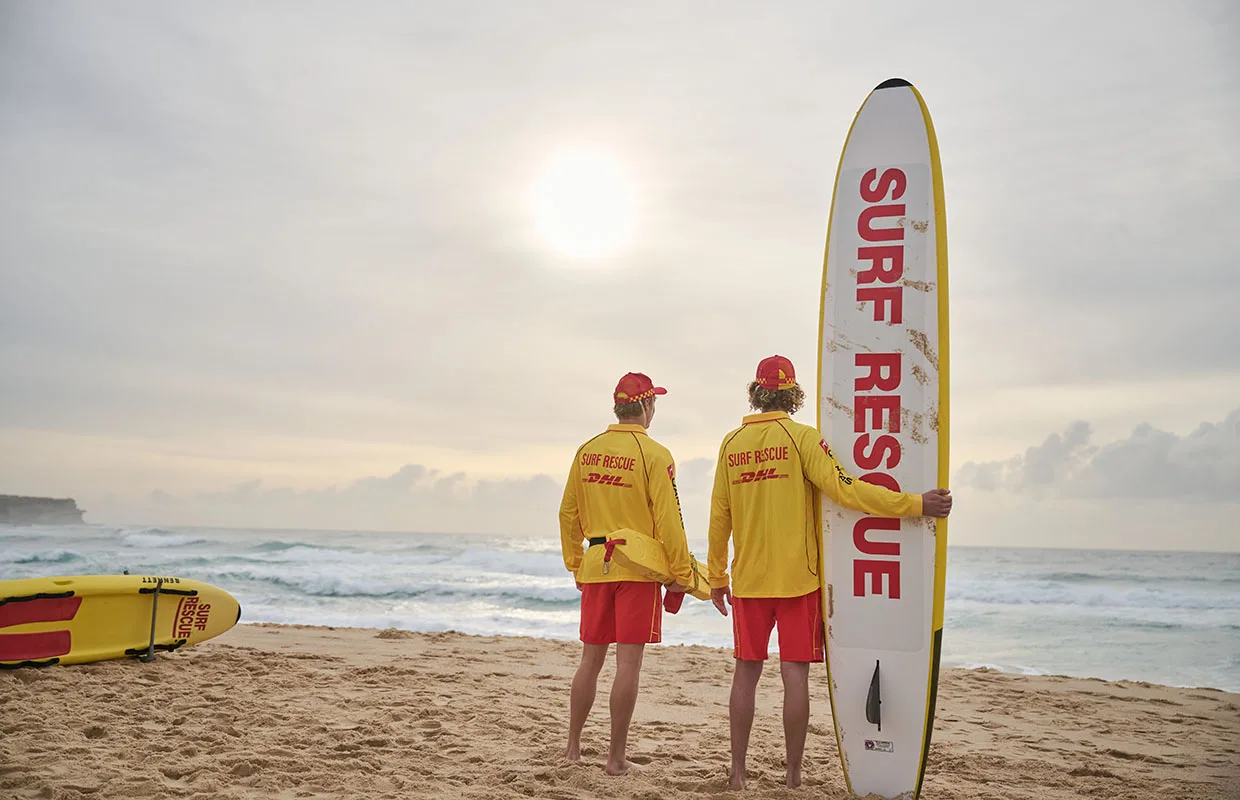
In the context of Australia’s unique geographical challenges and opportunities, we speak with Phil Corcoran, Managing Director of DHL Express Australia and Papua New Guinea. He shares insights on the company’s commitment to time-definite delivery, sustainable growth initiatives, and meaningful partnerships in line with DHL Group’s purpose – connecting people and improving lives.
DHL EXPRESS DELIVERING DOWN UNDER
In the ever-evolving world of logistics, Phil Corcoran stands out as the Managing Director of DHL Express Australia and Papua New Guinea, bringing nearly three decades of experience to the role.
Corcoran’s journey began in the late 80s working for a large Australian manufacturing company, where he first encountered the complexities of international trade, customs clearance, and shipping logistics.
His passion for the industry was ignited, but a yearning for adventure led him to embark on a year-long journey across Africa.
During this time, he was captivated by the global presence of DHL Group (DHL), the world’s leading logistics provider, which inspired him to join the company upon his return to Australia.
Now, with a wealth of knowledge and a commitment to sustainable growth, Corcoran is at the forefront of DHL Express Australia’s initiatives, focusing on environmental responsibility, enhancing service quality, and fostering meaningful partnerships, all whilst navigating the unique opportunities of the logistics landscape in Australia.

TIME-DEFINITE DELIVERY
At its core, time-definite delivery means that urgent international shipments reach their destination within a specified time frame.
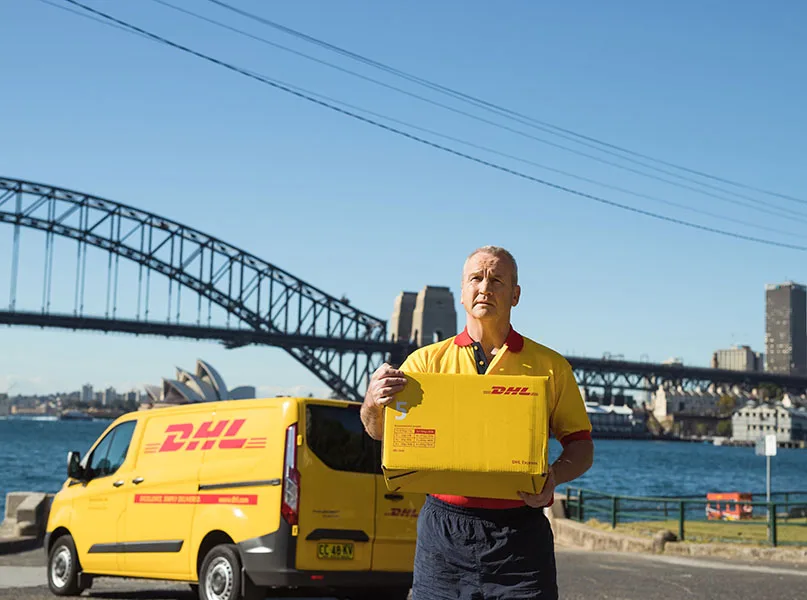
This is what DHL Express Australia, part of DHL Group, offers through the secure door-to-door delivery of goods with full track-and-trace visibility.
“Customers are paying for the speed, reliability, and security of our network and visibility of when their shipment is going to be delivered,” outlines Corcoran.
“Their demand for accurate shipment information is only increasing, so relying on digital systems and up-to-date information available online and integrated with customers is really important – far more so now than it ever used to be.”
Consistently delivering on time, and with visibility, remains quite a challenge for logistics companies in Australia due to its vast geography.
“We have a physical presence in the major population centres, but there are vast areas where we rely on third-party agents to deliver or pick up shipments for us. We’re aiming to expand our physical presence; when we do that, we improve the service quality for our customers.”
Australia is not shielded from current and increasing geopolitical challenges, including the new raft of US tariffs, which have had a big impact on exporters.
For many years, DHL has surveyed the export confidence of its customers and what they see as emerging trends, opportunities, and threats.
The latest DHL Export Barometer 2025 reveals how, despite the uncertainty created by the US tariffs, hope remains buoyant for Australian exporters, who are navigating a shifting global landscape with confidence, diversification, and new technology.
“Because we’re predominantly a business-to-business company, we see trends develop in trade based on geopolitical decisions, tariff introductions, and any conflicts in the world,” he explains.
“We also see an immediate impact on trade flows and volumes around the world in and out of Australia and internationally, so we view ourselves as a barometer for how trade is going.”
“Customers are paying for the speed, reliability, and security of our network and visibility of when their shipment is going to be delivered”
Phil Corcoran, Managing Director, DHL Express Australia and Papua New Guinea
GREEN LOGISTICS OF CHOICE
When DHL launched its Strategy 2030: Accelerate Sustainable Growth, the group took the bold step of introducing a new bottom line for its business to be the green logistics provider of choice.
This enables DHL customers to remove carbon from their supply chain which would otherwise be incurred by shipping packages.
The vast majority of DHL’s carbon emissions comes from its 300-strong aircraft fleet, which is a huge challenge without a viable alternative to traditional jet fuel.
However, fleet modernisation and sustainable aviation fuel (SAF) are both major focuses to reduce carbon emissions.
“Every time we replace an old aircraft, we make a dramatic saving in fuel consumption and carbon emissions,” Corcoran emphasises.
“Many of our customers are keen for us to help them inset carbon emissions, rather than offset them, by reducing the amount they generate through the shipments they send with us.
“By utilising SAF, we’re having a really positive impact as we press towards our global target of net zero by 2050,” he affirms.
DHL is also working internationally on the electrification of its massive ground fleet, reducing the reliance on fossil fuels to power its vehicles.
Electrification is one of the biggest levers in achieving net zero and involves replacing internal combustion vehicles with electric alternatives.
This is an important focus area for logistics as road freight is responsible for around 70 percent of emissions generated during overland
transportation.
“We will have globally electrified 60 percent of our ground fleet within the next couple of years – our goal was to do that by 2030,” Corcoran acclaims.
“It’s been a bit more challenging in Australia because as a country we haven’t invested fast enough for our fleets, not just at DHL but across the whole industry, to be able to accelerate as rapidly as other parts of the world towards electrified fleets, but we are making progress.”
SUSTAINABLE, AUTOMATED FACILTIES
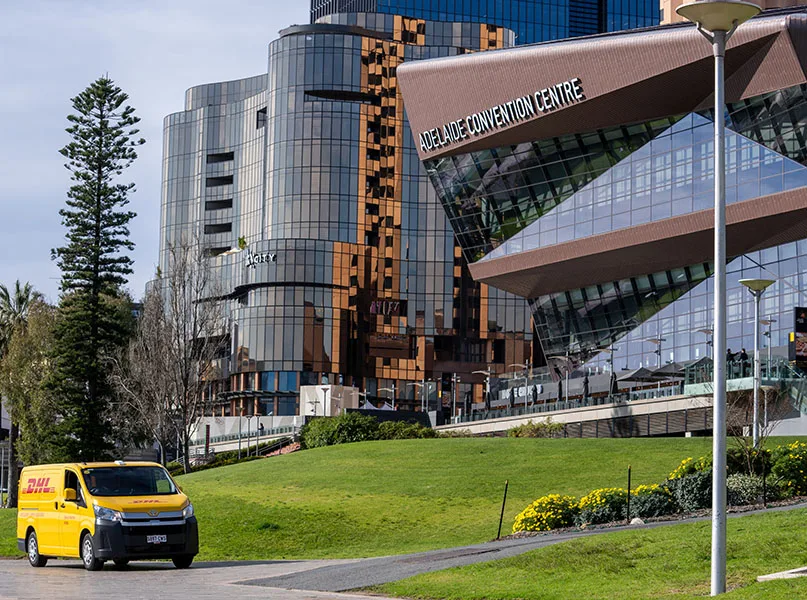
New facilities are also being developed with sustainability in mind, exemplified by DHL Express Australia’s new carbon-neutral sorting facility in Adelaide, which was launched in 2024 and marked a significant step towards sustainable logistics.
The Adelaide Gateway is a state-of-the-art logistics hub that not only accelerates international shipping times for South Australian customers but also showcases the company’s commitment to environmental responsibility.
The facility is also equipped with 199 solar panels, boasts an energy-efficient design, and incorporates a rainwater harvesting system.
“We’ve invested in fully automated sorting equipment, carbon-neutral buildings, solar generation, and rainwater reuse to better utilise electricity and dramatically reduce our footprint – it’s all happening as we develop our new facilities,” details Corcoran.
Automation is likewise implemented into sophisticated software to improve the accuracy of the customs clearance process that DHL performs on behalf of customers.
“It’s a lot of investment to make sure we’re doing that in a seamless and automated fashion because it’s a very complex process, but also a highly repeatable one as a lot of our customers send the same things to the same places every day,” he insights.
“If you can capture accurate data and use it effectively, you remove a lot of pain from what is traditionally quite a manual process.
“We still have multiple digitalisation opportunities that will make life easier for our customers and staff, so that will remain a focus for us as we continue to invest,” Corcoran confirms.

“We will have globally electrified 60 percent of our ground fleet within the next couple of years – our goal was to do that by 2030”
Phil Corcoran, Managing Director, DHL Express Australia and Papua New Guinea
GROWTH INDUSTRY VERTICALS
DHL is investing in its capability to capitalise on the anticipated growth in those industries over the coming years.
“In these verticals, the customer feedback is they want more choice in terms of logistics. DHL is investing to meet growing demand,” notes Corcoran.
DHL will accelerate collaboration with sister business units, not just the Express division.
“In Australia, DHL Supply Chain, who specialise in product warehousing, picking and packing, and distributing for customers, are heavily integrated into most of the major health companies that operate in the country,” he tells us.
“If we can collaborate more effectively with our sister business units, like DHL Supply Chain, we will accelerate our ability to offer integrated services across the group to our shared customers.”
CONNECTING PEOPLE AND IMPROVING LIVES
Over many years, DHL Express Australia has developed purposeful partnerships that align with DHL’s purpose.
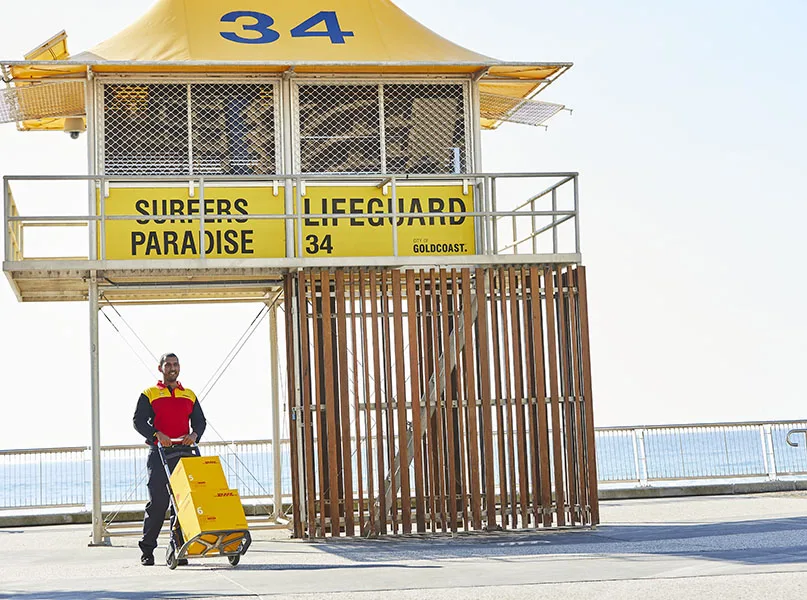
Since 2003, it has partnered with Surf Life Saving Australia (SLSA), the country’s peak coastal water safety, drowning prevention, and rescue authority, contributing to its vision of zero preventable deaths in Australian waters.
“SLSA volunteers keep beaches safe, prevent drownings, and minimise injuries around the country, particularly at this time of the year as it gets warmer and everyone heads to the beach,” Corcoran highlights.
“They’re a huge part of the Aussie culture and an iconic movement. They also share the red and yellow colours of DHL and our values in terms of wanting to help communities.
“The partnership has only survived for as long as it has because we’ve got great people on both sides who bring it to life,” he acknowledges.
Another organisation DHL Express Australia has partnered with is Stepping Stone House, a Sydney-based charity that provides accommodation, life skills, and employment development support for homeless and at-risk youth.
“Their goal is to end youth homelessness entirely, and they’ve been extremely successful in lobbying government to support vulnerable kids. I’ve personally got deeply involved in Stepping Stone House and they do amazing work,” reflects Corcoran.
Amongst many others, DHL Express Australia also works with the DV Collective, who provide urgent assistance, essential resources, and long-term solutions for women and children escaping domestic violence, as well as children’s cancer charity, Camp Quality.
Then there’s global DHL partner, ChildFund Pass It Back, an innovative sport for development programme that delivers an integrated life skills and rugby curriculum for children and young people in disadvantaged communities across Asia.
“Historically, DHL and rugby have very close ties. We do a lot of work to support the programme in developing countries and less fortunate parts of developed countries, including Australia,” informs Corcoran.
PRIORITIES TO DELIVER
DHL Express Australia’s meaningful partnerships will continue into the future, along with several other important priorities.
“It’s about being a great place to work, the best possible logistics provider for our customers, and a sustainable organisation for future generations, whilst making sure we remain compliant in all areas of governance,” Corcoran summarises.
“There are huge risks around cybersecurity and work health and safety that we need to remain vigilant about. We also need to do things efficiently, keep an eye on costs, and invest wisely, leveraging the opportunities in new energies, life sciences, and healthcare.
“All of this – under our Strategy 2030 to accelerate sustainable growth – is what we need to focus on over the coming year,” he concludes.